Thursday, August 26, 2010

Indian Idols - Naturally!

Celebrations of Indian festivals, like most of our customs, result in a lot of social interaction. Ganesh Chaturthi stems from a point in time, post Independence, when reformers were trying to bring about a dynamic change in societal practices. Lokmanya Tilak gathered together locals to celebrate the ‘Ganesh Chaturthi’ festival as an occasion that would foster unity and community interaction.  Though this tradition of community celebrations is prevalent across India even today, it has ignored a very crucial aspect - the environment; in fact, many of our celebrations, now more commercial than social in nature, result in air, noise and water pollution.  

Take our celebration of Ganesh Chaturthi. Plaster of Paris used to create the Ganpati idols does not dissolve easily in water and hence they remain undissolved long after their immersion. The toxic paints used pollute water bodies, harm marine life and eventually enter the food chain. 

It is heartening though that in the past few years, increased environmental awareness particularly among the younger generation is leading to a welcome change. Hopefully, this year the idols will make their eco-friendly presence felt in a  big way. A Sindhudurg based sculptor, Pramod Palav got few of the basic raw materials in place – a mix of clay, fig tree juice, paper and glue – to create idols that will dissolve in water in less than 15 minutes. These eco-friendly idols are certified by the National Environmental Engineering Research Institute.

According to the guidelines by the Central Pollution Control Board, idols should be made from materials like traditional clay instead of plaster of Paris or baked clay. You can also use natural colours like turmeric, geru and multani mitti. Once the idol is immersed in a bucket at home, you can use the water for your plants. The numerous flowers used for pooja can be replaced with plants, which could then be planted in your neighbourhood. The ‘nirmalya’ or offerings can be segregated so the bio-degradable component can be composted.

‘What's in our heart is what matters’, says Jeevanlal, who has switched to eco-friendly Ganesh festivities.

Perhaps this time the festival is set to bring about another social change, for the environment, for our sustainable existence.

For more details on eco-friendly idols you can look up for ‘Green Ganesha’ Times of India initiative at www.timesgreenganesha.com

“God wishes to see people happy, amidst the simple beauty of nature” – Anne Frank

Friday, August 20, 2010

Blowin’ in the Wind

How many years will our forests exist
Before they end up in smoke?
How many years will our people exist
If they think the forest’s a joke?
Listen. How many crops will a desert produce?
And how much water to drink?
The answer, my friend, is blowin’ in the wind
The answer is blowin’ in the wind 

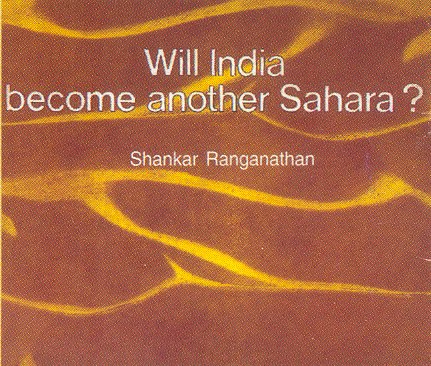
This poem, based on Bob Dylan's famous song, was  written almost presciently 30 years ago,  by  G. Shankar Ranganathan, Chairman, Ion Exchange  as the lead-in to his  book 'Will India become another Sahara?''.

Friday, August 13, 2010

Let's Be Freedom Fighters


The concept of freedom is not new to living beings, especially humans. The fact that we strive hard for food, shelter & clothing but fight even harder for freedom speaks for itself. The joy of true freedom was experienced by the entire nation midnight 15th August, 1947. After being enslaved for 350 years, the bird flew out of its cage.

With hope in our hearts & heads full of dreams, we marched towards a new world, envisioning a world of progress, a better life. But progress came at a cost. Speaking from the Indian perspective, the industrial boom, then population explosion and urbanisation, poverty, illiteracy, corruption, pollution and environment degradation have all  been an inherent, interlinked and embarrassing truth.    Worse, these problems have only increased with time, getting deeper by the roots & stronger by the motives. Chained by reality, every passing decade has seen fundamentals wronged at every step.

Undoubtedly efforts have been made towards eradication of many of our problems.  And though they have not been sufficient or successful enough to take us from our darkest points to the "white" light of freedom, we must at least grasp the grey.  White may be unattainable...for now. But grey definitely shouldn't be.  And eventually, sooner or later, break all chains. And be free, once again.

Our nation’s freedom struggle has been a lesson to the world. Let’s be freedom fighters once again.  Let’s join hands and make a pledge – to freedom.

- Ruchi Sanganeria


Thursday, August 5, 2010

With Hope & Faith – Save our Planet

As far as making a point is concerned, this one is direct - a funeral pyre on which a huge, charred ball is placed, the embers lying scattered around it. Former professor at JJ School of Arts and guru to some of the most well-known senior creative directors in advertising, Shantaram Pawar's installation aptly sums up the message: how man's greed and callousness, is leading to the earth’s slow but sure death.
Similar thoughts have been expressed by 25 other communication artists, most of them ex-JJites, to emphasise their concern for Mother Earth and the future of mankind, in the show titled Rutusamhar (destruction of the seasons). Visit Rutusamhar at JJ Art Gallery, from 10 am to 6 pm till August 8.
The idea for an art exhibition for the green cause came about six months back when Pawar showed his poem lamenting the state of the environment to one of his closest friends C Gangadharan Menon, a travel writer and ex-ad man. "He wanted to make leaflets of the poem and distribute it with newspapers or give it to students on campus. But it wouldn't have made any impact," says Gangadharan. The duo then hit upon the idea to pass the poem to professionals in the field, most of them Pawar's students and ask them to interpret it the way they desired. The result is art works in various forms: paintings, posters, sculptures, terracotta work and installations, each of which emphasises the artist's hope and anguish about the destruction of the environment.
The common factor lies in the simplicity of the artworks Ad professional Arun Amberkars installation of a skeleton of an umbrella looks like a bare tree sans the green canopy. Or Gangadharan's paintings which represent Brahma and Vishnu from the famed troika. You look out for the painting of the destroyer. What you get instead is a mirror. It couldn't get more stark than that.
(Mumbai Mirror, 4/08/10)

Monday, August 2, 2010

Promise to Nature On Friendship Day

For centuries nature has been the best friend we could have. On Friendship Day, what we ought to do is re-think our relationship with her. We have defaced and disrespected her, insulting her unconditional friendship. Let's all pledge to make a new vow of friendship with nature, and nurture her like she has nurtured us. The poem below summarises the message we must reflect on as friends of nature.
Nature - My Friend


Nature, to me a special friend
Shade and shine and rain afresh
Glade of peace
The sun in strength
The night song in beauty drenched

Beast & fowl in my hand placed
Plant and soil that grow with grace
From them my every need appeased
Even to fulfill selfish greed

The hidden stream, to quench my thirst
The forest green, to eat my fill
A child to her bosom held
She blessed in love - gave of herself

Woe, to me, the condemnable crook
Who in ungratefulness lays her glory waste
If my friend’s heart with fullness gave,
Why? Oh, why, did my human spirit fail?

The raging storm is testament
And so is the whirling hurricane
In her hand, and her creator’s,
is power to purge my covetousness

In her abode my home is made
With her resource my house is carved
Without her help in ruins will lie
My every plan; the progress which I pride

But still to me she bows her head
And the scepter places in my hand
Stubbornly she seeks in me
Justice, kindness and integrity

For my friend
From whom I gladly robbed
It’s time to reciprocate her love
With a healer’s touch
And a benevolent gaze
I’ll remedy each crime
And wipe her tears.


-  Carissa Paul

Friday, July 30, 2010

Doomsday for Waste!

Recycling is no longer an option. It has to be a way of life. With the increasing amounts of waste generated, what better way to solve the waste-full problem at offices than organise an innovative recycle drive to reuse waste generated in offices, as a group activity.

'Doom's Day' held annually at Ion Exchange is certainly not as ominous as it sounds. All it involves is setting aside of time – a day, once a year, by all employees at a location to clear their work space of all the unwanted papers that have accumulated during the year. These unwanted papers are then recycled - the single-side printed papers are reused for printing drafts etc. or are bound into "rough" note pads.The double-sided used papers are shredded and used as packing.

Our Rabale office conducted its paper clearance drive, ‘Doom’s Day’ on July 17th, and guess what? They collected around 5000 kgs of unwanted paper that is now being reused.

Added benefits are a cleaner, better organised work space - and more space!

" Work is indeed worship, and by conducting the Doom’s Day drive, we brought about a clean and clear working area.. After all the office is where we spend almost 9 hours of a day and we all keep our places of worship pure!" said GK Ghadi, one of the organisers of 'Doomsday' at Ion Exchange, Rabale.

Charity begins at home. ‘Clear-ity’ begins at work.

Tuesday, July 27, 2010

An Inconvenient Truth – Film Review

‘An Inconvenient Truth’, a documentary by director Davis Guggenheim, has the former US Vice President Al Gore take the audience through what we call ‘Global Warming’ , exposing the myths & misconceptions about it. The fact that we are causing an irreparable damage to the earth becomes glaring especially when Gore shows a balance with earth on one side & gold on the other. Erroneously we choose the latter and how! Below are excerpts of reviews.

By Larry West in About.com Guide

http://environment.about.com/od/aninconvenienttruth/fr/goremovie.htm

It is hard to imagine anything more boring in concept than a documentary film of a politician presenting a slide show about a complex scientific subject. But this is no ordinary slide show, Al Gore is no ordinary politician, and An Inconvenient Truth is almost certain to be the most important film you will see this year—or any year.

In An Inconvenient Truth, Gore combines objective scientific evidence, humor and personal insights to create a powerful 80-minute exploration of what he clearly believes is the most critical issue of this or any other time in human history.

Gore has been a student of climate change since the 1960s. He knows his subject, he has done his homework, and he presents a compelling case for urgent and immediate action to turn back global warming.

Gore is clearly passionate about his subject. His mission is not merely to inform, but to motivate. He wants his audience not only to understand, but to take action. As Gore explained during a question and answer session at a preview of the film I attended in early May, "If you believe the science, then what else matters?"

By David Remnick in The New Yorker 
http://www.newyorker.com/archive/2006/04/24/060424ta_talk_remnick#ixzz0sPZHXL93

“An Inconvenient Truth” is, to be perfectly honest (and there is no way of getting around this), a documentary film about a possibly retired politician giving a slide show about the dangers of melting ice sheets and rising sea levels. It has a few lapses of mise en scène. Sometimes we see Gore gravely talking on his cell phone—or gravely staring out an airplane window, or gravely tapping away on his laptop in a lonely hotel room—for a little longer than is absolutely necessary. And yet, as a means of education, “An Inconvenient Truth” is a brilliantly lucid, often riveting attempt to warn Americans off our hellbent path to global suicide. “An Inconvenient Truth” is not the most entertaining film of the year. But it might be the most important.